To feel the danger, you have to know the box they built. God’s Law, given through Moses, treated adultery as so serious it could carry the death penalty — and everyone in the temple knew it. But Israel was under Rome now, and Rome had taken over the death penalty: a Jewish court could still condemn a person, but it could not lawfully carry out an execution without the Roman governor (“we are not permitted to put anyone to death,” the leaders admit at Jesus’ own trial, John 18:31). So “what do You say?” had two doors, and both were traps. Say stone her, and Jesus breaks Roman law and looks like a rebel. Say let her go, and He looks like He is throwing out the Law of Moses. There was no safe answer — which is the whole point (v. 6): they were never really after the woman. They were after Him.
Play it hands-free — great for the drive
Tap play, then lock your phone or set it in the car. It keeps playing with the screen off and shows on your lock screen and car display — pause and skip from your steering wheel.
The one person who never has to choose between justice and mercy
Early one morning in the temple, Jesus is teaching when His enemies drag in a woman and a question sharp enough to end Him: Moses said stone her — what do You say? Say yes and He collides with Rome; say no and He throws out God’s Law. Watch how He answers — without ever pretending that sin isn’t sin.
Follow the story down the page
The whole study hangs on one sentence: In Jesus, justice and mercy meet — He springs the trap without once pretending that sin doesn’t matter. The story runs straight down, one scene at a time. Open a drop-down wherever you want more: the culture and background (🏚), the original words (✦), or the Old-Testament laws (📜). Every 🏫 schoolhouse panel teaches you how to do that step yourself — Kay Arthur for observing, Ray Vander Laan for the land and law, and Duvall & Hays for crossing from their world to ours.
📖 Read all of John 7:53–8:11 (marked) — or just follow the story below
👀 Read it like a detective — observe before you interpret
- Who’s missing? Adultery takes two, and the law they quote punished both (Lev 20:10). The man is nowhere. The first crack in their “justice.”
- Who’s the real target? Verse 6 tells us out loud: they were “testing Him.” The woman is bait; Jesus is the one on trial.
- Repetition: stone (vv.5,7), wrote on the ground (vv.6,8), and condemn (vv.10,11) each repeat — watch what they frame.
- The one silence that speaks: the only place in all four Gospels where Jesus writes — and Scripture never says what. Don’t fill the blank; feel it.
- The turn (irony): the accusers arrive to judge and leave judged — “beginning with the older ones,” the ones with the longest memory of their own sin.
- Where it sits: right after the hostility of John 7, and right before “I am the Light of the world” (8:12) — light that exposes hidden sin, then offers itself as the way out.
The trap that couldn’t fail
Why this was a no-win question
📜 The very verses they were quoting
Read these before the John passage — they are the Old Testament laws in the accusers’ minds when they say “Moses commanded us.” Notice as you read what their trap quietly leaves out.
Leviticus 20:10 — “If there is a man who commits adultery with another man’s wife, one who commits adultery with his friend’s wife, the adulterer and the adulteress shall surely be put to death.”
→ Both the man and the woman were guilty — so where is the man?
Deuteronomy 22:22 — “If a man is found lying with a married woman, then both of them shall die, the man who lay with the woman, and the woman; thus you shall purge the evil from Israel.”
→ “Both of them” again — the same missing man.
Deuteronomy 22:23–24 — “If there is a girl who is a virgin engaged to a man, and another man finds her in the city and lies with her, then you shall bring them both out to the gate of that city and you shall stone them to death… the man, because he has violated his neighbor’s wife.”
→ Stoning is named for a betrothed woman — likely why the accusers specifically say “stone.”
Deuteronomy 17:6–7 — “On the evidence of two or three witnesses… he shall be put to death… The hand of the witnesses shall be first against him to put him to death, and afterward the hand of all the people.”
→ The eyewitnesses had to throw the first stone — the exact nerve pressed in verse 7.
Read these laws in full on Bible Gateway →
🏺 The trap, the law, and Roman rule — why this was a no-win question
Three background facts make the fork a real trap. One: the Law (Lev 20:10; Deut 22:22–24) punished both parties in adultery, with stoning named for a betrothed woman — so bringing only the woman was already a distortion. Two: under Roman rule the Jewish council could still hand down a death sentence but had lost the authority to carry it out without the governor’s approval (“We are not permitted to put anyone to death,” John 18:31) — so a “yes, stone her” would set Jesus against Rome. (Mobs did stone people anyway — Stephen in Acts 7 — but as lynchings, not lawful court sentences; and when the high priest Ananus had James the brother of Jesus stoned about AD 62, he did it in the gap between governors and was removed for overstepping. The one standing exception Rome allowed was executing anyone who trespassed into the inner temple courts.) Three: Deuteronomy 17:7 required the eyewitnesses to throw the first stones, which is exactly the nerve Jesus presses. He neither denies the Law nor walks into Rome’s reach — he exposes the accusers instead.
Just how touchy was Rome about unauthorized killing? Touchy enough that even a riot was risky. Years later in Ephesus, a mob furious at Paul’s preaching seized two of his traveling companions, Gaius and Aristarchus, and packed the city theater, roaring “Great is Artemis of the Ephesians!” for about two hours (Paul’s own friends kept him from going in). It was the city clerk who finally calmed them — and the way he did it is the tell: he warned that the whole city was “in danger of being accused of a riot,” with no real case they could give Rome for the uproar (Acts 19:23–41). If a proud, self-governing city was afraid of how Rome would react to a mere disturbance, then a public stoning carried out on the temple steps — a real execution, not just a shouting match — would have been far more dangerous. That is exactly the corner the accusers were trying to back Jesus into: get Him to call for blood, and let Rome do the rest.
🏫Find the world behind the trapWhat law, custom, or political fact is assumed here
- Ask: what would the first hearers simply know that we don’t? (Here: the Law on adultery, and that carrying out a death sentence needed Rome’s approval.)
- Look it up in a Bible dictionary or STEP Bible — enough to see why the question was a trap.
- Ask what that pressure would make Jesus’ answer cost Him.
The drop-down above is that homework done for you — the Law, Rome, and the no-win fork.
Dawn in the temple
Before the storm (7:53–8:2)
The night before, everyone had gone home; Jesus had gone out to the Mount of Olives — His habit of slipping away to pray. At first light He is back in the temple courts, sitting down like a rabbi, and a crowd gathers to hear Him teach. It is an ordinary, hopeful morning. Hold onto that picture — because it is about to be interrupted.
🗺️ An interesting point to consider — where was He headed?
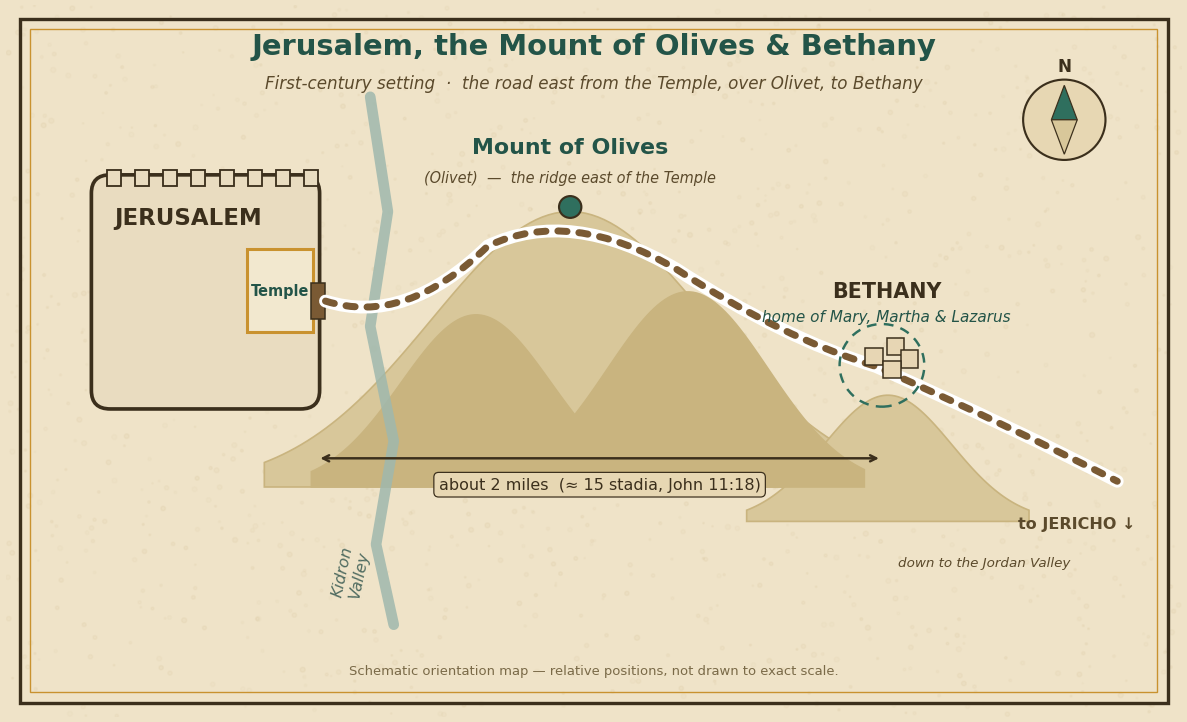
The text only says “Jesus went to the Mount of Olives” (8:1) — but think about what lay just over that hill. The Mount of Olives is the ridge directly east of the temple, and on its far eastern slope, about two miles out along the road toward Jericho, sat the village of Bethany (John 11:18). Bethany was the home of Mary, Martha, and Lazarus — the family Scripture plainly says Jesus loved (John 11:5; and see Martha welcoming Him into her home in Luke 10:38–42).
Because Bethany sits on the Mount of Olives, the Gospels can describe His nights near Jerusalem two different ways without any conflict: Luke says He spent His nights “on the mount that is called Olivet” (Luke 21:37), while Matthew and Mark say He lodged in Bethany (Matthew 21:17; Mark 11:11). Same direction, same hill. So when John says He headed for the Mount of Olives, He was setting out on the very road to His friends’ door — and many people think that is right where He stayed.
Hold it loosely, though. Those “lodged in Bethany” verses come from the final Passover week; our scene is months earlier, at the Feast of Tabernacles, and the text here stops at the mountain without naming a house. So picture it as a rich possibility — the Teacher with no room in the city walking toward the one home where He was simply loved and welcomed — rather than something the verse states outright.
🖼️ See it: the road east from the Temple, over Olivet, to Bethany
📖 What each sentence is saying — the verses in this scene
“Everyone went to his home. But Jesus went to the Mount of Olives.”
What it’s saying: The crowd scatters home for the night; Jesus, with no home in Jerusalem, spends the night out on the Mount of Olives, just east of the temple. It’s a quiet hinge between the day’s arguments and the morning’s confrontation.
🌍 In their world: Pilgrims flooding Jerusalem for a feast often camped on the surrounding slopes; the Mount of Olives, a short walk over the Kidron Valley, was a natural place to lodge.
“Early in the morning He came again into the temple, and all the people were coming to Him; and He sat down and began to teach them.”
What it’s saying: At dawn Jesus is back, teaching in the most public religious space in the nation. Sitting is the posture of an authoritative teacher — picture a professor at the front of a packed hall. This is the setting the accusers choose to hijack.
🌍 In their world: A rabbi taught seated while listeners stood or sat around him. Doing this in the temple courts put Jesus on the biggest, most watched “stage” available — exactly why a public trap would sting most here.
🏫Observe before you interpretRead like a detective — notice, don’t explain yet
- Read the scene two or three times, slowly.
- Mark the setting words — temple, early morning, sat down and taught.
- Ask who is present and who is not; hold the questions for later.
Open “Read all of John 7:53–8:11” up top and flip the marking toggle.
The woman in the middle
The trap is sprung (vv. 3–6a)
The scribes and Pharisees push through the crowd and stand a woman in the center of the courtyard — “caught in the act,” they say. Then they quote the Law and aim it: “Moses commanded us to stone such women. What do You say?” John tells us their real aim in plain words: they said this to test Him, so they could accuse Him (v. 6). The woman is not their concern; she is bait. And already something is wrong with their courtroom — adultery takes two, and the Law they quote punished both (Lev 20:10). The man is nowhere to be seen.
📖 What each sentence is saying — the verses in this scene
“The scribes and the Pharisees brought a woman caught in adultery, and having set her in the center of the court, they said to Him, ‘Teacher, this woman has been caught in adultery, in the very act.’”
What it’s saying: The religious experts parade a woman into the middle of the crowd. “In the very act” means caught red-handed — which quietly raises the question of who was watching, and where the man is, since he was caught too.
🌍 In their world: This was an honor-and-shame culture, where public exposure was itself a punishment. Standing a woman “in the center” at dawn was designed to humiliate her before the whole gathering.
“Now in the Law Moses commanded us to stone such women; what then do You say?”
What it’s saying: Here’s the fork in the trap. They cite Moses and demand a ruling. If Jesus says “stone her,” he defies Rome (which reserved the right to authorize an execution) and loses his mercy; if he says “let her go,” he seems to overturn the law of Moses in public.
Compare translations
NASB95 “Moses commanded us to stone such women; what then do You say?”
“Now Moses in the law commanded us, that such should be stoned: but what sayest thou?”“Now in our law, Moses commanded us to stone such women. So what do you say about her?”“Now in the law Moses commanded us to stone such: what then sayest thou of her?”
🌍 In their world: Under Roman rule the Jewish council had lost the right to carry out the death penalty (“We are not permitted to put anyone to death,” John 18:31). That legal reality is what turns a Bible question into a live trap.
✦ Word secrets: “caught in adultery” & “testing”
Moicheia is marital unfaithfulness; katalambanō means to seize or catch red-handed. Together: “caught in the very act.” The word choice underlines how staged it was — someone had to be positioned to catch her, yet only she was hauled in.
↑ Back to the passageThe same word used for Satan “tempting” Jesus in the wilderness. John isn’t guessing at motives — he tells us straight out this is a trap, not an honest legal question. It sets the whole scene: the woman is bait; Jesus is the target.
↑ Back to the passage📜 The Law they quoted
The law the accusers quote sentenced both the man and the woman — and stoning specifically was named for a betrothed woman (Deut 22:23–24). So a listener who knew the Law would immediately notice the missing man and the selective “justice.” The accusers weren’t upholding Moses; they were weaponizing him.
↑ Back to the passage🏫Do a quick word studyLet one Greek word open the scene
- Pick a loaded word — try “testing” or “condemn.”
- Look it up in a free interlinear like STEP Bible.
- Note its range of meaning and where else it’s used.
The word cards in this scene are that study done for you.
The finger in the dust
One sentence turns the trap around (vv. 6b–8)
Instead of answering, Jesus stoops down and writes on the ground with His finger — the only time in all four Gospels we are told He wrote, and we are never told what. They keep pressing. Then He straightens up and says one sentence that flips the whole scene:
He isn’t throwing out the Law — He is using it. The Law itself said the witnesses must throw the first stones (Deut 17:7). Jesus simply asks: is there a witness here clean enough to start? Then He stoops and writes again, and lets the silence do the work.
📖 What each sentence is saying — the verses in this scene
“They were saying this, testing Him, so that they might have grounds for accusing Him. But Jesus stooped down and with His finger wrote on the ground.”
What it’s saying: John hands us the motive plainly — this is a setup, not a sincere case. Jesus’ first move is to say nothing and write on the ground. The text never tells us what he wrote, so neither will we; the silence itself refuses to feed the spectacle.
🌍 In their world: This is the only scene in the Gospels where Jesus writes. Ancient guesses abound (the accusers’ sins? a verse of law?), but the earliest readers were left, like us, with a deliberate blank.
“He who is without sin among you, let him be the first to throw a stone at her.”
What it’s saying: Jesus doesn’t cancel the law — he adds a qualifier for who’s fit to enforce it. Under Moses, the eyewitnesses had to throw first (Deut 17:7). Jesus asks whether these “witnesses” are clean enough for the job. It punctures self-righteousness, not justice.
Compare translations
NASB95 “He who is without sin among you, let him be the first to throw a stone at her.”
“He that is without sin among you, let him first cast a stone at her.”“He who is without sin among you, let him throw the first stone at her.”“He that is without sin among you, let him first cast a stone at her.”
✦ Word secret: “without sin”
Appears only here in the whole New Testament. Jesus isn’t saying only perfect people may ever uphold a law — society couldn’t run that way. In context it means: you who are so eager to be the executioner, are your own hands clean of this same kind of sin? It targets self-righteousness, not justice.
↑ Back to the passage📜 The witnesses throw first
Moses commanded that the eyewitnesses to a capital crime cast the first stones — a safeguard meant to make accusers absolutely sure. When Jesus says “let him who is without sin throw first,” he lands right on this rule: Are you fit to be that witness? He upholds the Law even as he disarms its abuse.
↑ Back to the passage🗺️ The temple courts at dawn
The scene sits in the temple complex — the vast public plaza at the heart of Jerusalem, crowded during a feast. Teachers gathered listeners in its courts; Jesus had spent the night just east on the Mount of Olives, crossing the Kidron Valley back at first light. Placing the confrontation here, in the open, in front of pilgrims, is what made the intended public humiliation — and Jesus’ public reversal of it — land so hard.
Placeholder for a verified BiblePlaces.com photo of the Temple Mount / Mount of Olives — to be added and link-checked before publish.
🏫Catch the Old-Testament echoWhat older law was already in their ears
- When a scene turns on the Law, ask which command is in play.
- The 📜 marks jump straight to it — here, the rule that witnesses cast the first stone (Deut 17:7).
- Read the older passage first, then hear Jesus’ line the way they did.
The drop-downs here hold the exact laws the trap depended on.
One by one, oldest first
The judges become the judged (v. 9)
No one moves — and then someone does. One by one they drift away, John notes, beginning with the older ones. The men who dragged her in to be judged walk out judged themselves, the eldest leading the retreat, until the courtyard holds only two: the woman still standing where they left her, and Jesus. The trap is empty. Not one stone was thrown.
📖 What each sentence is saying — the verses in this scene
“Again He stooped down and wrote on the ground. When they heard it, they began to go out one by one, beginning with the older ones, and He was left alone, and the woman, where she was, in the center of the court.”
What it’s saying: No stones fly. One by one the accusers walk away — the oldest first. The men most experienced in life (and most aware of their own record) are the first to admit they’re not qualified to throw. The trap collapses.
🌍 In their world: Age carried honor and authority; for the elders to leave first was a public admission that dissolved the whole prosecution. The crowd would have read it instantly.
🏫Watch the contrasts and the ironyThe turn is where the meaning lives
- Notice the reversal: the judges walk out judged.
- Notice the order: “beginning with the older ones.” Why the eldest first?
- Notice who is left, and what was not thrown.
Marking the movement of people through a scene is pure inductive observation.
Neither do I condemn you
Justice and mercy, in one breath (vv. 10–11)
Jesus straightens up and speaks to her — the first person all morning to treat her as a person. “Woman, where are they? Did no one condemn you?” “No one, Lord.” And then the sentence the whole scene was built to reach: “Neither do I condemn you; go, and from now on sin no more.” Hear both halves. He does not pretend the sin didn’t happen — “sin no more” names it plainly. And He does not hand her over — “neither do I condemn you” sets her free. The one person in that courtyard with the right to throw a stone is the one who refuses to.
Strip away the temple and the trap, and three things stay true today. Jesus alone holds justice and mercy together — we usually pick one and lose the other. Our rush to condemn others often hides how much mercy we ourselves have needed. And His mercy is never a shrug — it always says, “go, and sin no more.”
📖 What each sentence is saying — the verses in this scene
“Straightening up, Jesus said to her, ‘Woman, where are they? Did no one condemn you?’ She said, ‘No one, Lord.’ And Jesus said, ‘I do not condemn you, either. Go. From now on sin no more.’”
What it’s saying: The two lines the whole story drives toward. “I do not condemn you” is not “you did nothing wrong” — it means “I’m not passing the death sentence.” “Sin no more” is not a cold add-on — it’s mercy pointing her toward a new life. Keep both, or you don’t have this story.
Compare translations
NASB95 “I do not condemn you, either. Go. From now on sin no more.”
“Neither do I condemn thee: go, and sin no more.”“Neither do I condemn you. Go your way. From now on, sin no more.”“Neither do I condemn thee: go thy way; from henceforth sin no more.”
✦ Word secrets: “condemn” & “sin no more”
To hand down a guilty verdict with its punishment. So “I do not condemn you” does not mean “you did nothing wrong” — it means “I am not passing the death sentence on you.” That’s why the very next word (“sin no more”) is essential: mercy, but not approval.
↑ Back to the passageThe tense points to an ongoing way of life, not a single act — “stop walking this road.” Jesus names her behavior as sin in the same breath he spares her. Grace is never a shrug; it’s a rescue that calls you forward.
↑ Back to the passage🅍 Cross the bridge: the full journey from their world to ours (5 steps)
The Interpretive Journey
Good study doesn’t stop at “what it meant back then” or jump straight to “what it means to me.” It travels the distance carefully — from the original audience, across the differences, to the timeless principle, and only then home to us.
What it meant to the first hearers
What did the text mean to the biblical audience?In the Jerusalem temple during the feast, Jesus’ opponents used a woman caught in adultery to trap him between the law of Moses and the limits of Roman rule. Jesus refused the trap: he exposed the accusers’ own guilt until none was fit to throw the first stone, then neither carried out the death sentence on the guilty woman nor excused her sin — he released her and told her to leave her sinful life. The crowd saw Jesus reveal that he alone had the authority both to judge sin truthfully and to forgive it mercifully, and that self-righteous accusers stood condemned by their own consciences.
Measure the differences between them and us
What separates the biblical situation from ours?We don’t live under Roman occupation or the Sanhedrin’s courts; we don’t stone anyone. And we stand on this side of the cross — the one truly “without sin” went on to bear sin’s condemnation himself so mercy and justice could meet. But the human realities on both banks are identical: real sin, real guilt, the itch to condemn others, and the need for both truth and mercy.
The timeless theological principle
What truth crosses over from then to now?Jesus alone holds the right both to judge sin truthfully and to forgive it fully. Those who are aware of their own sin have no standing to condemn others self-righteously — and the mercy Jesus gives is never permission to keep sinning, but a summons to a changed life.
How it fits the rest of Scripture
Does this principle hold across the whole Bible?Cleanly. “You who pass judgment do the same things” (Rom 2:1); “all have sinned” (Rom 3:23); Jesus “did not come to judge the world, but to save it” (John 3:17); “no condemnation for those in Christ” (Rom 8:1); yet grace is never a license to keep sinning (Rom 6:1–2). The principle doesn’t lean on this disputed passage alone — the whole Bible already teaches it.
How we live it out today
How should we apply it now?Watch a famous misreading first: “Neither do I condemn you” is often pulled out to mean “Jesus never calls anything sin, so no one can ever say anything is wrong.” But that drops “sin no more,” said in the same breath. Keep both. Be someone who remembers your own record before you reach for a stone — the oldest men dropped theirs first. Think by holding truth and grace together, refusing our culture’s split of “don’t judge anything” versus “no mercy at all.” Do: put the stone down when the crowd (or the internet) piles on someone already shamed; when you forgive, love the person enough to also point toward a better path; and if you are the one caught and ashamed, hear the actual words of Jesus — he does not condemn you, and he believes you can walk a new road. Receive both.
🏫Cross the bridge & applyCarry the meaning from their world to ours — carefully
- Their town: what it meant then.
- Measure the river: we don’t stone offenders or stand in a first-century temple court.
- Cross the bridge: in Jesus, justice and mercy meet.
- Our town: one stone to set down, or one mercy to receive, this week.
Never start at application — earn it by crossing.
Now listen for His voice
We’ve leaned on a lot of help to build this study — the original Greek, first-century maps, the oldest manuscripts, cross-references, and yes, even a computer to gather and arrange it all. Every one of those is a gift, and they can sharpen our grasp of what the text meant in its own world. But not one of them can make the Word come alive in your heart. Only the Holy Spirit does that. The tools are servants; He is the Teacher.
Sit for a moment in that courtyard. Feel the stones go quiet, the accusers walk away, and only Jesus and the guilty are left — and that’s all of us. Hear him say the two things together, because he means both: I do not condemn you, and go, and sin no more. He is the only Judge with the right to end you, and he chooses to free you and call you forward. Don’t rush past either half.
- Be still. Set the screen down for a moment and quiet your heart. “Be still, and know that I am God” (Psalm 46:10).
- Ask Him to open your eyes. “Open my eyes, that I may behold wonderful things from Your law” (Psalm 119:18).
- Read the passage once more, slowly — and ask, “Father, by Your Spirit, what are You saying to me in this, today?”
- Listen, and hold on to the one thing that rises up. Write it down.
- Then obey it. Jesus said the one who keeps His word is the one who truly loves Him (John 14:21).
“Holy Spirit, thank You for the Scriptures and for every help that opens them to us. Now do what no tool can: take what this passage meant then and make it Your living word to me today. Quiet my heart, show me Jesus, and give me the grace to receive both His mercy and His call — ‘neither do I condemn you… go, and sin no more.’ In His name, amen.”
Take it deeper during the week
The teaching above stands on its own. These are here for your own study through the week.
🔗 Connections across the whole Bible
Consult the biblical map
| Passage | Connection |
|---|---|
| Romans 2:1 | Those who judge others “practice the same things” — the accusers exactly. |
| Romans 3:23 | “All have sinned” — no one in the courtyard was qualified to throw. |
| John 3:17 | Jesus came “not to judge the world, but to save it” — “I do not condemn you.” |
| Romans 8:1 | “No condemnation for those in Christ” — where the woman’s release ultimately points. |
| Romans 6:1–2 | Grace is no license to keep sinning — “sin no more.” |
| Deuteronomy 17:6–7 | The witnesses throw first — the law Jesus presses in v.7. |
| John 8:12 | “I am the Light of the world” — the very next scene; light that exposes and then saves. |
| James 4:12 | “There is only one Lawgiver and Judge” — and he is standing in the courtyard. |
🎬 Go deeper: watch, study tools & discussion questions
Resources to explore
🎬 Watch & listen
- BibleProject — Gospel of John (Part 1)The overview video plus its study page.
- BibleProject — Guide to the Book of JohnKey background and free resources for the whole Gospel.
- Podcast: Jesus’ Identity in John’s GospelBibleProject — who is the One who can say “neither do I condemn you”?
📖 Study tools (free)
- STEP Bible — John 8Free interlinear, Greek words, and concordance (Tyndale House).
- NET Bible — John 8 with translators’ notesSee the translation and manuscript decisions behind each verse.
- BibleHub — John 8 interlinearWord-by-word Greek with parsing.
📚 Reference shelf
- Craig Keener, The IVP Bible Background Commentary: New TestamentVerse-by-verse first-century background for the scene.
- Bruce Metzger, A Textual Commentary on the Greek New TestamentThe standard summary of the manuscript evidence for this passage.
- D. A. Carson, The Gospel According to John (Pillar)Careful exegesis, including the text-critical question handled fairly.
Discussion questions
- Observe: Verse 6 tells us what the accusers actually wanted. What was it — and who is conspicuously missing from the scene?
- Interpret: How does Jesus’ answer in verse 7 avoid the trap without denying the law of Moses?
- Interpret: Why does Jesus say both “I do not condemn you” and “sin no more”? What goes wrong if you keep only one of those lines?
- The bridge: What timeless principle carries from that temple courtyard all the way to us today?
- Live it (last): Where are you most tempted to pick up a stone — and where do you most need to hear “neither do I condemn you”?
📊 The shape of the scene & the manuscript question
📜 The manuscript question, in full
John 7:53–8:11 (called the pericope adulterae, “the passage about the adulteress”) is absent from the earliest and most reliable Greek copies of John, including the earliest near-complete copies from the AD 200s. When it does appear in later copies, it turns up in different locations — after John 7:36, at the end of John, or even in Luke after 21:38. Its vocabulary and style differ somewhat from the rest of John. For these reasons most scholars across traditions conclude it was not part of John’s Gospel as originally written, which is why modern Bibles bracket it. At the same time, many of those scholars regard the story as a genuine, very early tradition about Jesus — treasured enough to be preserved and eventually written in. Bottom line for our study: handle it with care, don’t build doctrine on it alone, and notice that everything it shows about Jesus is confirmed elsewhere in Scripture.