Event 9 — The Birth of Jesus in Bethlehem
The most powerful man on earth signs a tax decree, and the whole Roman world starts moving — never guessing that his order is carrying a poor couple to the one town a prophet had named 700 years before.
Caesar rules in name; God rules in fact
Luke frames the birth between two thrones. At the top is Caesar Augustus, master of the known world, whose decree sends millions to their hometowns to be counted and taxed. At the bottom is a baby in a feeding trough in a crowded village. Yet it is the baby’s arrival, not the emperor’s, that history will turn on. Without knowing it, Caesar’s census carries Joseph and Mary to Bethlehem — the city of David — exactly where the prophet Micah said the Ruler of Israel would be born. The King of kings enters His world in poverty and obscurity, and that lowliness is not an accident; it is the point.
The text
Underlined words (like manger) link down to their original-language card in Word secrets below.
1Now in those days a decree went out from Caesar Augustus, that a census be taken of all the inhabited earth. 2This was the first census taken while Quirinius was governor of Syria. 3And everyone was on his way to register for the census, each to his own city. 4Joseph also went up from Galilee, from the city of Nazareth, to Judea, to the city of David which is called Bethlehem, because he was of the house and family of David, 5in order to register along with Mary, who was engaged to him, and was with child.
6While they were there, the days were completed for her to give birth. 7And she gave birth to her firstborn son; and she wrapped Him in cloths, and laid Him in a manger, because there was no room for them in the inn.
Luke 2:1–7 (NASB95)📖 Read the whole passage
Read it on Bible Gateway (NASB 1995). Notice how much room Luke gives to Caesar, Quirinius, and the census — he is anchoring the birth in real, datable history, and quietly contrasting the empire’s machinery with the quietness of what God is actually doing.
What the original words mean
Five words that change the picture most of us grew up with.
A Roman census was about money and control — counting people so they could be taxed and conscripted. Augustus meant it as a show of imperial power. Luke shows it serving a purpose the emperor never intended: moving the Messiah’s family to the prophesied town. The empire’s paperwork becomes God’s delivery system.
↑ Back to the passageMore than birth order. In Israel the firstborn son carried special standing — he was to be consecrated to the Lord (which sets up Event 11–12). The word also became a title for the Messiah’s supremacy (Colossians 1:15–18). Luke plants it here in its plainest sense, but it will blossom.
↑ Back to the passageThis was ordinary, tender care — snug strips of cloth that every newborn was bound in. Luke mentions it twice (here and as the shepherds’ sign), underlining the sheer normal humanity of it. The eternal Son enters the world as a real baby needing to be wrapped and held.
↑ Back to the passageNot a crib but the place animals ate from. In a village home, people lived on a raised level and animals were brought into a lower area at night; the manger was right there. The detail says it plainly: there was no proper place, so the newborn King was laid where the animals fed.
↑ Back to the passageNot a roadside hotel with a heartless innkeeper — that’s a later legend. The word means a guest room (it’s the same word for the “upper room” of the Last Supper in Luke 22:11). The family’s guest space was already full, likely with other relatives back for the census, so the baby was placed in the household’s animal quarters.
↑ Back to the passageFrom Nazareth to the city of David
Bethlehem lay about six miles south of Jerusalem in the hills of Judea — David’s hometown, and the town Micah named. Joseph, of David’s line, had to register there.
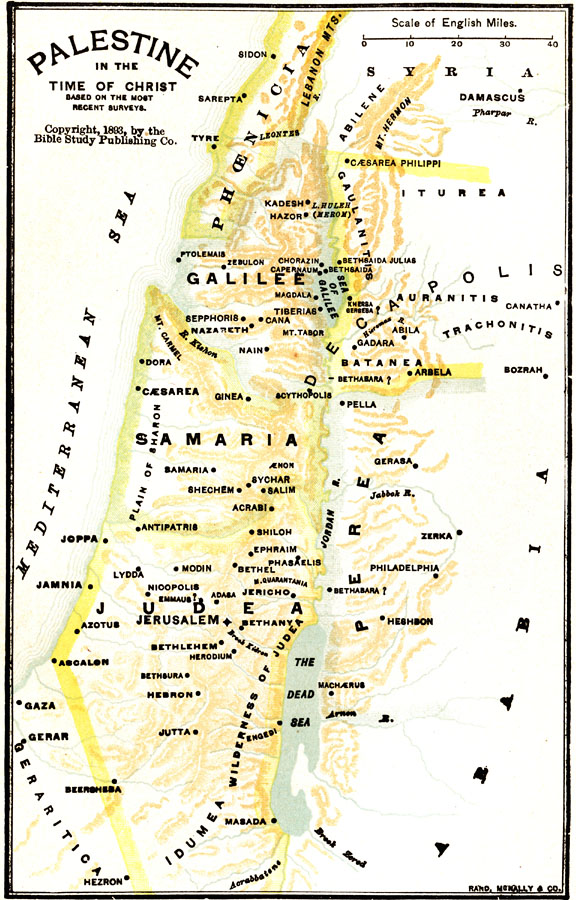
🏺 The manger, the guest room, and a village full of relatives
The familiar nativity scene — a lonely couple turned away by a cruel innkeeper — owes more to later tradition than to Luke. The word translated “inn” (katalyma) is a guest room, not a commercial inn (Luke uses a different word for a real inn in the Good Samaritan story). In a typical Judean village home, the family lived on a raised platform while animals were kept in a lower area of the same room at night, with a feeding trough cut into the floor. With the town swollen by census travelers, the guest space was taken, so the baby was laid in the household manger. The picture is not cruelty but crowded, ordinary poverty — the King of glory welcomed into the humblest corner of a working family’s home.
📜 A prophecy 700 years old
The prophet Micah, around 700 B.C., had named the town: “But as for you, Bethlehem Ephrathah, too little to be among the clans of Judah, from you One will go forth for Me to be ruler in Israel” (Micah 5:2). When Herod later asks his scholars where the Messiah is to be born, they quote this verse without hesitation (Matthew 2:5–6). Caesar’s tax decree is the unwitting instrument that lands the Messiah’s birth exactly on target.
A thinking tool: inversion
Look at who seems to hold the power — and who actually does
“Invert, always invert.” Luke sets the scene so the obvious center of power and the real center of power are opposites. Caesar issues the decree; the whole world jumps. Yet the verse the future will remember is not about Caesar at all.
The titles Rome stamped on its emperor — son of god, savior, bringer of peace — Luke quietly hands to the child in the manger. The whole Gospel will keep making this move: real power wears the disguise of weakness, and the throne of this King turns out to be a cross.
How it ties to the rest of Scripture
| Passage | Connection |
|---|---|
| Micah 5:2 | Bethlehem, “too little” among Judah’s clans, named 700 years ahead as the Ruler’s birthplace. |
| 1 Samuel 16:1–13 | Bethlehem as the city of David, where the shepherd-boy was anointed king — now the greater Son of David is born. |
| Isaiah 9:6–7 | “A child will be born to us… on the throne of David” — the royal hope behind the manger. |
| 2 Corinthians 8:9 | “Though He was rich, yet for your sake He became poor” — the meaning of the manger, stated. |
Resources to explore
Play the video here, then dig into the text and its background.
🎬 Watch & listen
- Video: BibleProject — Luke 1–9Overview with study notes and downloads.
- Podcast: An Overview of LukeLuke’s emphasis on the lowly, the poor, and God’s reversal.
📖 Study tools
- Luke 2:7 interlinear + Strong’sSee “manger” (phatnē) and “inn” (katalyma) in the Greek.
- Full passage (Luke 2:1–7, NASB95)Read the whole text on Bible Gateway.
🔗 Cross-reading
- Micah 5:2–5The prophecy of the Ruler from Bethlehem.
- Matthew 2:1–6Herod’s scholars quote Micah without hesitation.
Discussion questions
- Luke spends three verses on Caesar, Quirinius, and the census before he even reaches the birth. To a first-century reader living under Rome, what is the effect of opening the King’s story that way?
- Romans called Augustus “son of god,” “savior,” and the bringer of peace. How would Luke’s first readers have heard those same titles landing on a baby in a manger?
- Knowing that the “inn” was a full guest room and the manger a household feeding trough, how does the real scene differ from the one on most Christmas cards — and does it change anything?
- Micah named Bethlehem 700 years earlier. What does it say about God that He used the most powerful empire on earth, through an ordinary tax law, to keep that promise?
- Only after seeing all that does the question reach us: the King who was “rich” chose to be born poor. What does the manger teach us about the kind of God we are dealing with?