Event 6 — The Visitation & the Magnificat
Two mothers meet in the hill country — one old, one young, both carrying impossible sons. An unborn baby leaps for joy, and a peasant girl answers with one of the greatest songs ever sung.
The song of the great reversal — God keeping His ancient promise
Mary travels south to her relative Elizabeth, and the moment she arrives, the child in Elizabeth’s womb leaps and Elizabeth is filled with the Spirit. Then Mary sings. Her song — called the Magnificat, from its first word in Latin, “magnifies” — is soaked in the Old Testament: God scatters the proud, pulls down rulers, lifts up the humble, fills the hungry, and remembers His mercy to Abraham. To a people under Rome, longing for God to act, this is not a sweet lullaby; it is a revolution announced in advance — and it is God being faithful to a promise centuries old.
The text
Underlined words (like magnifies) link down to their original-language card in Word secrets below.
39Now at this time Mary arose and went in a hurry to the hill country, to a city of Judah, 40and entered the house of Zacharias and greeted Elizabeth. 41When Elizabeth heard Mary’s greeting, the baby leaped in her womb; and Elizabeth was filled with the Holy Spirit. 42And she cried out with a loud voice and said, “Blessed are you among women, and blessed is the fruit of your womb! 43And how has it happened to me, that the mother of my Lord would come to me? 44For behold, when the sound of your greeting reached my ears, the baby leaped in my womb for joy. 45And blessed is she who believed that there would be a fulfillment of what had been spoken to her by the Lord.”
46And Mary said:
“My soul exalts the Lord, 47and my spirit has rejoiced in God my Savior. 48For He has had regard for the humble state of His bondslave; for behold, from this time on all generations will count me blessed. 49For the Mighty One has done great things for me; and holy is His name. 50And His mercy is upon generation after generation toward those who fear Him.
51He has done mighty deeds with His arm; He has scattered those who were proud in the thoughts of their heart. 52He has brought down rulers from their thrones, and has exalted those who were humble. 53He has filled the hungry with good things; and sent away the rich empty-handed. 54He has given help to Israel His servant, in remembrance of His mercy, 55as He spoke to our fathers, to Abraham and his descendants forever.”
56And Mary stayed with her about three months, and then returned to her home.
Luke 1:39–56 (NASB95)📖 Read the whole passage
Read it on Bible Gateway (NASB 1995). Mary’s song closely echoes the song of Hannah in 1 Samuel 2:1–10 — another once-shamed woman praising the God who reverses fortunes. Reading the two together is part of the lesson.
What the original words mean
Five words that carry the weight of the song.
In the Greek Old Testament, kyrios was the word that stood in for the divine name, Yahweh. Filled with the Spirit, Elizabeth calls the unborn child “my Lord” — the older woman honoring the younger, the forerunner’s mother bowing to the King’s. Status is already being turned upside down.
↑ Back to the passageElizabeth names what sets Mary apart: not her youth or her worthiness, but her faith. The contrast with Zechariah hangs in the air — he asked for proof and was silenced; Mary believed and is called blessed. Luke is teaching his readers what a right response to God’s word looks like.
↑ Back to the passageThe Latin translation of this word, magnificat, gives the song its name. Mary doesn’t make God bigger than He is; she makes Him look as big as He truly is — her whole self enlarging His greatness so others can see it. The song is worship before it is anything else.
↑ Back to the passageThe same word the Greek Old Testament uses for Hannah’s “affliction” and Leah’s “misery.” Mary names her real social smallness — a poor girl from a nowhere town — and says God looked right at it. The whole song flows from this: God’s habit of noticing exactly the people the world overlooks.
↑ Back to the passageFor God to “remember” is not to recall something forgotten; it is to act on a promise He made. The mercy Mary names reaches back to Abraham (v.55). The song ends by anchoring this whole moment in the covenant — God is not improvising; He is keeping His word.
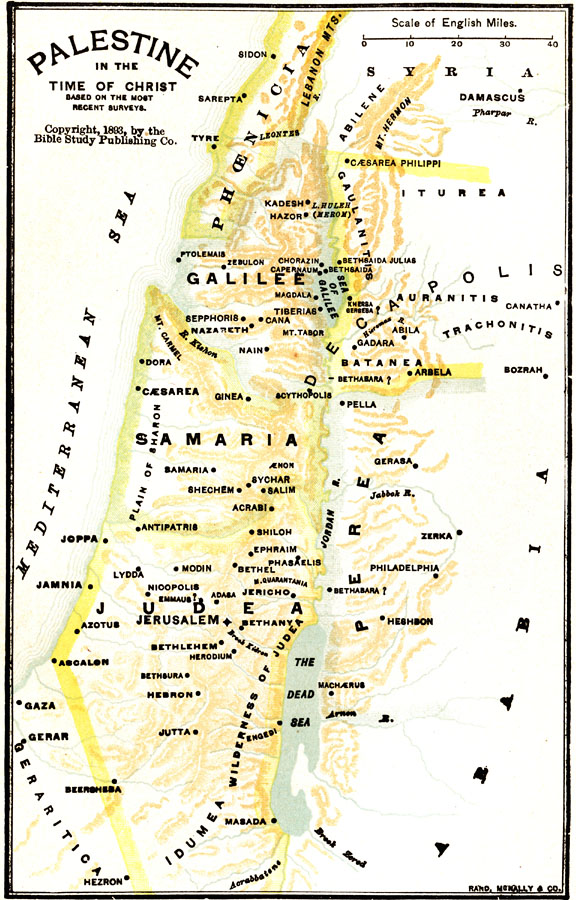
↑ Back to the passageFrom Galilee to the hill country of Judah
Mary’s journey was no short stroll: from Nazareth in the north down to a village in the Judean hills near Jerusalem — roughly 70–90 miles on foot, several days’ travel for a young girl.
🏺 A song the poor would have recognized
Mary’s words would not have sounded strange to her first hearers — they are stitched together from the Psalms, the Prophets, and especially Hannah’s song (1 Samuel 2). In an honor-and-shame world ruled by Rome and its local strongmen, “He has brought down rulers from their thrones and exalted those who were humble” was dangerous, hopeful poetry. The God of the covenant was on the side of the lowly, and a teenage girl was singing it out loud.
A thinking tool: inversion
The Magnificat is the great reversal, sung out loud
The song is built on a hinge: every line about the proud has a matching line about the humble. To feel what the kingdom is, look at what it overturns. This is the same inversion Gabriel set up in Event 5 — now Mary names it directly, verse by verse.
Crucially, this reversal is not random. The song roots it in “the mercy He spoke to Abraham” (v.54–55): God is keeping an ancient covenant. The kingdom Jesus brings will run on this upside-down logic the whole way to the cross — the King Himself taking the lowest place.
How it ties to the rest of Scripture
| Passage | Connection |
|---|---|
| 1 Samuel 2:1–10 | Hannah’s song — the once-barren mother praising the God who “raises the poor from the dust.” Mary’s song is patterned on it. |
| Genesis 12:1–3 | The promise to Abraham that Mary says God is now remembering — blessing for all the families of the earth. |
| Psalm 103:17 | “The lovingkindness of the Lord is… to generation after generation toward those who fear Him” — quoted almost word-for-word in v.50. |
| 2 Samuel 22:28 | “You save an afflicted people, but Your eyes are on the haughty whom You abase” — the reversal Mary sings. |
Resources to explore
Play the video here, then dig into the text and its background.
🎬 Watch & listen
- Video: BibleProject — Luke 1–9Overview with study notes and downloads.
- Podcast: An Overview of LukeLuke’s heart for the poor, the outsider, and the lowly.
📖 Study tools
- Luke 1:46 interlinear + Strong’sSee “magnifies” (megalynō) in the Greek.
- Full passage (Luke 1:39–56, NASB95)Read the whole text on Bible Gateway.
🔗 Cross-reading
- 1 Samuel 2:1–10Hannah’s song — the model behind the Magnificat.
- Genesis 12:1–3The promise to Abraham that God is “remembering.”
Discussion questions
- Filled with the Spirit, Elizabeth — the older woman, mother of the forerunner — calls Mary “the mother of my Lord.” What is Luke showing his readers about status in this kingdom before Jesus is even born?
- Mary’s song is woven from Hannah, the Psalms, and the Prophets. What does it tell us that a teenage girl’s instinctive praise is this saturated with Scripture?
- To a first-century Jew under Rome, “He has brought down rulers from their thrones” was bold, even dangerous. How would those words have landed on the poor of Mary’s world?
- The song ends by anchoring everything in God’s “mercy to Abraham.” Why does it matter that the great reversal is rooted in an ancient promise rather than a new idea?
- Only after all that does the question reach us: Mary magnifies the Lord from a place of real lowliness. What would it look like for our worship to start where hers does?