Event 30 — Jesus Leaves Judea for Galilee
A few quiet travel verses carry three weighty things: a wise withdrawal, John’s arrest, and one small phrase — “He had to pass through Samaria” — that turns a route into a rescue.
A strategic withdrawal — and a route chosen on purpose
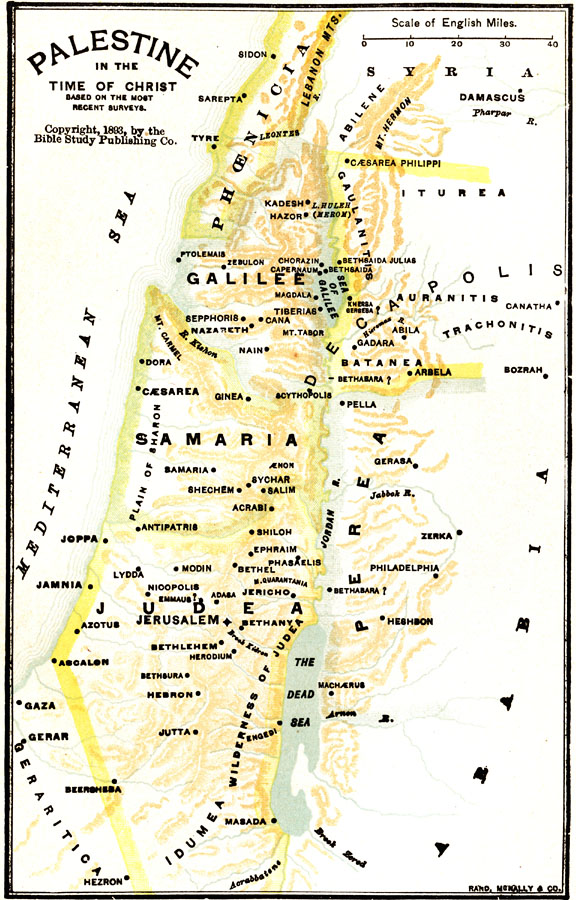
Jesus’ growing crowds have caught the Pharisees’ attention, so He leaves Judea and heads back to Galilee — not from fear, but from wisdom, declining to force a showdown before His time. At the same moment, the forerunner who said “He must decrease” literally decreases: Herod Antipas throws John the Baptist in prison for confronting his sin. And John’s Gospel drops one loaded detail about Jesus’ journey: “He had to pass through Samaria.” Devout Jews usually went the long way around Samaria to avoid its despised people. Jesus “had to” go straight through — a necessity of mission, not geography. The detour that wasn’t a detour is about to lead Him to a well, and to one unforgettable woman.
The text
Underlined words (like had to pass through) link down to their original-language card in Word secrets below.
1Therefore when the Lord knew that the Pharisees had heard that Jesus was making and baptizing more disciples than John 2(although Jesus Himself was not baptizing, but His disciples), 3He left Judea and went away again into Galilee. 4And He had to pass through Samaria.
Luke records what had happened to John: 19But when Herod the tetrarch was reproved by him for Herodias, his brother’s wife, and for all the wicked things which Herod had done, 20he added this also to them all: he locked John up in prison.
John 4:1–4; Luke 3:19–20 (NASB95)📖 Read it in context
Read John 4:1–4 and Luke 3:19–20. Matthew adds that “when Jesus heard that John had been taken into custody, He withdrew into Galilee” (Matthew 4:12). The harmony lays these together: the forerunner steps off the stage as the Messiah moves toward His Galilean ministry.
What the original words mean
Four details that make a travel note glow.
Matthew uses Jesus’ signature word here — He “withdrew” (anechōrēsen) — the same strategic stepping-back we saw when His family avoided Archelaus. This is not retreat in weakness but timing: Jesus refuses to be rushed into conflict before His “hour.” He governs the pace of His own story.
↑ Back to the passageThat little word “had to” (edei) is the same divine “must” the boy Jesus used in the temple. Geographically He did not have to — many Jews deliberately went around Samaria. The necessity is in heaven’s plan, not the map: a Samaritan woman is waiting at a well, and the Father has an appointment to keep.
↑ Back to the passageSamaria lay directly between Judea and Galilee, but centuries of bad blood made it the region Jews most avoided. To say Jesus “had to pass through Samaria” is to say He chose the path of contact rather than the path of avoidance — heading straight toward the very people His culture skirted.
↑ Back to the passageHerod Antipas jails John for telling the truth about Herod’s marriage. The man who had just said “I must decrease” now decreases in the hardest way — into a cell. Faithfulness cost John his freedom and, soon, his life. The forerunner’s path of decrease foreshadows the road his Lord will walk.
↑ Back to the passageThe road most Jews refused to take
Samaria sat squarely between Galilee and Judea. Many Jews crossed the Jordan to go around it rather than set foot among the Samaritans. Jesus took the direct road, straight through.
🏺 Herod Antipas, Herodias, and a costly rebuke
The “Herod” here is Herod Antipas, a son of Herod the Great and tetrarch (ruler of a quarter) over Galilee and Perea. He had taken Herodias, his own brother’s wife, and John publicly named it as sin. Rulers rarely forgive that, and Antipas locked John away (and later, pressured by Herodias, had him beheaded). Luke places this arrest here to mark a handoff: the forerunner’s public work is ending just as Jesus’ Galilean ministry begins. The voice in the wilderness goes silent in a cell — faithful to the last.
📜 Why Jews and Samaritans avoided each other
The hostility went back centuries. After Assyria conquered the northern kingdom (722 B.C.), it resettled the area with foreign peoples who intermarried with the Israelites left behind (2 Kings 17:24–41); Judeans came to regard the resulting Samaritans as impure half-breeds. The two peoples worshiped at different mountains, kept different scriptures, and despised one another. So a Jewish rabbi voluntarily walking into Samaria — and stopping to ask a Samaritan woman for a drink, as the next event tells — was startling. Jesus’ “had to” quietly announces that His mission will cross the very lines His world drew hardest.
How it ties to the rest of Scripture
| Passage | Connection |
|---|---|
| Matthew 4:12 | Jesus “withdrew into Galilee” on hearing of John’s arrest — the same move, told from Matthew’s angle. |
| 2 Kings 17:24–41 | The origin of the Samaritans — the background to the “had to pass through.” |
| Luke 2:49 | “I had to be in My Father’s house” — the same divine “must” that drives Jesus through Samaria. |
| Acts 1:8 | “Jerusalem… Samaria… the ends of the earth” — the mission to Samaria that Jesus begins here. |
Resources to explore
Play the video here, then dig into the text and its background.
🎬 Watch & listen
- Video: BibleProject — John 1–12Overview with study notes and downloads.
- Podcast: Jesus’ Identity in John’s GospelHow John portrays who Jesus is.
📖 Study tools
- John 4:4 interlinear + Strong’sSee “had to (edei) pass through Samaria” in the Greek.
- Full passage (John 4:1–4, NASB95)Read it on Bible Gateway.
🔗 Cross-reading
- Matthew 14:1–12The rest of John the Baptist’s story under Herod.
- Acts 8:4–25The gospel later sweeping through Samaria.
Discussion questions
- Jesus withdraws rather than force a confrontation with the Pharisees. What does it show about Him that He governs the timing of His own mission?
- “He had to pass through Samaria” — though geographically He didn’t. What does that divine “must” reveal about how God arranges seemingly ordinary travel and timing?
- Most Jews avoided Samaria entirely. What does Jesus’ choice of the direct road say about who His mission is for?
- John had said “I must decrease,” and now decreases into a prison cell. How does his faithfulness under cost deepen the meaning of those words?
- Only after all that does the question reach us: behind a plain travel note, God was keeping an appointment at a well. Where might God be at work in the ordinary “routes” of our own days?