Event 19 — John the Baptist Begins
Four hundred years of prophetic silence break in a desert. A man dressed like Elijah stands by the Jordan and shouts a single, scandalous command to God’s own people: repent, and get the road ready — the King is coming.
Prepare the way — the kingdom comes through repentant hearts
The hidden years end not with Jesus but with His forerunner. In the wilderness of Judea, John appears with a message as old as the prophets and as sharp as a blade: “Repent, for the kingdom of heaven is at hand.” He quotes Isaiah — “Prepare the way of the Lord” — and his baptism in the Jordan is a stunning demand: he calls Jews, the covenant people, to be washed as if they were unclean outsiders who must start over with God. Birthright won’t save them; only real repentance, bearing real fruit, will. And John keeps pointing past himself to One coming who is mightier — who will baptize not just with water but with the Holy Spirit and with fire.
The text
Underlined words (like repent) link down to their original-language card in Word secrets below.
1In those days John the Baptist came, preaching in the wilderness of Judea, 2saying, “Repent, for the kingdom of heaven is at hand.” 3For this is the one referred to by Isaiah the prophet when he said, “The voice of one crying in the wilderness, ‘Make ready the way of the Lord, make His paths straight!’”
4Now John had a garment of camel’s hair and a leather belt around his waist; and his food was locusts and wild honey. 5Then Jerusalem was going out to him, and all Judea and all the district around the Jordan; 6and they were being baptized by him in the Jordan River, as they confessed their sins.
7But when he saw many of the Pharisees and Sadducees coming for baptism, he said to them, “You brood of vipers, who warned you to flee from the wrath to come? 8Therefore bear fruit in keeping with repentance; 9and do not suppose that you can say to yourselves, ‘We have Abraham for our father’; for I say to you that from these stones God is able to raise up children to Abraham. 10The axe is already laid at the root of the trees; therefore every tree that does not bear good fruit is cut down and thrown into the fire.”
11“As for me, I baptize you with water for repentance, but He who is coming after me is mightier than I, and I am not fit to remove His sandals; He will baptize you with the Holy Spirit and fire. 12His winnowing fork is in His hand, and He will thoroughly clear His threshing floor; and He will gather His wheat into the barn, but He will burn up the chaff with unquenchable fire.”
Matthew 3:1–12 (NASB95)📖 Read the fuller accounts
Read Matthew 3:1–12 and Luke’s longer version, Luke 3:1–18, which adds John’s practical counsel to the crowds (“the one who has two tunics is to share”), tax collectors, and soldiers. Luke 3:1–2 also pins the date to named rulers — Tiberius, Pilate, the Herods, Annas and Caiaphas — anchoring it in real history.
What the original words mean
Five words at the heart of John’s message.
Not merely feeling sorry — metanoia is a turning of the whole person, a U-turn of mind and life. John isn’t asking for a mood; he wants a new direction that shows up in “fruit.” The kingdom is arriving, and the only way to be ready is to turn from sin and toward God.
↑ Back to the passageFrom Isaiah 40:3. When a king traveled, crews went ahead to clear and level the road. John says the King is coming — so level the ground of your heart: fill in the low places, pull down the proud heights. The image of road-building becomes a picture of repentance making a people ready.
↑ Back to the passageWashings were familiar in Israel, and Gentile converts were baptized when they joined the covenant people. John’s shock is to make Jews do it — treating the chosen people as if they, too, needed to come clean and start over. Confessing sins in the Jordan, the nation is symbolically re-entering the land, ready for a new beginning.
↑ Back to the passageTo the religious elite who come trusting their pedigree, John is blistering: snakes fleeing a brush fire. Descent from Abraham won’t save them; only repentance that produces real change — “fruit” — counts. And “the axe is already laid at the root”: the time to turn is now, not later.
↑ Back to the passageJohn’s water points to a far greater baptism only the Coming One can give. The Spirit will fill and renew; the fire will both purify and judge — like a farmer’s winnowing fork separating wheat from chaff. John won’t even claim the slave’s job of untying His sandals. The forerunner’s whole aim is to make himself smaller so the King looms larger.
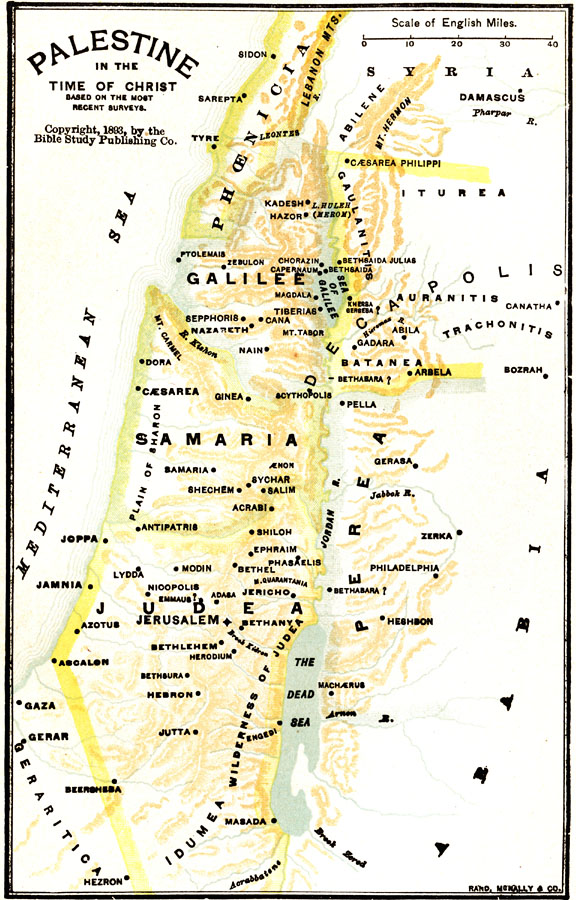
↑ Back to the passageA prophet in the wilderness, by the Jordan
John preaches in the barren wilderness of Judea, down by the Jordan River — the very place Israel once crossed to enter the Promised Land. The setting itself preaches a new beginning.
🏺 Why John’s baptism was so shocking
Ritual washing was nothing new in Israel — people purified themselves at the temple, and the Qumran community by the Dead Sea washed often. What was new and offensive was the audience. Jews generally assumed they were already “in” by birth; the people who needed a cleansing bath to join God’s people were Gentile converts. By calling Jews to a baptism of repentance, John was effectively saying: covenant pedigree is not enough — you, too, must turn and start over. That is why he scorns “we have Abraham as our father.” The chosen people themselves needed to come down into the river and confess.
📜 Elijah has come — the prophet behind the camel’s hair
John’s wardrobe is a quotation. Elijah was described as “a hairy man with a leather belt around his waist” (2 Kings 1:8), and Malachi had promised that God would send “Elijah the prophet” before the great day of the Lord, to turn hearts back (Malachi 4:5–6). Gabriel had told John’s father he would go “in the spirit and power of Elijah” (Luke 1:17). Dressed like the old prophet, standing in the wilderness, John is the living sign that the promised forerunner has arrived — and so the King cannot be far behind.
How it ties to the rest of Scripture
| Passage | Connection |
|---|---|
| Isaiah 40:3–5 | “A voice… prepare the way of the Lord” — the prophecy John fulfills. |
| Malachi 4:5–6 | The promised “Elijah” who turns hearts before the day of the Lord. |
| 2 Kings 1:8 | Elijah’s hairy garment and leather belt — the look John deliberately wears. |
| Acts 19:1–5 | John’s baptism pointed forward — “believe in the One coming after,” that is, Jesus. |
Resources to explore
Play the video here, then dig into the text and its background.
🎬 Watch & listen
- Video: BibleProject — Luke 1–9Overview with study notes and downloads.
- Podcast: An Overview of LukeHow John’s call to repentance opens Jesus’ ministry.
📖 Study tools
- Matthew 3:11 interlinear + Strong’sSee “baptize with the Holy Spirit and fire” in the Greek.
- Full passage (Luke 3:1–18, NASB95)Read Luke’s longer account on Bible Gateway.
🔗 Cross-reading
- Isaiah 40:1–11Comfort and the highway for our God.
- Malachi 3:1–4The messenger who prepares the way.
Discussion questions
- After four centuries with no prophet, John appears dressed like Elijah in the wilderness. What would all those signals have stirred in a first-century Jewish crowd?
- John makes Jews undergo a baptism normally reserved for Gentile converts. What was he saying about birthright, and why would that have been so offensive to the religious leaders?
- John defines real repentance as “bearing fruit,” not just feeling sorry or claiming Abraham as ancestor. How does that sharpen what genuine turning to God looks like?
- The forerunner’s whole strategy is to shrink so the Coming One looms larger (“not fit to remove His sandals”). What does John model about pointing to Jesus rather than ourselves?
- Only after all that does the question reach us: John told everyone the kingdom was “at hand” and to get the road ready. What might “preparing the way” in our own hearts look like?