Event 17 — The Boy Jesus at the Temple
The one story Scripture gives us from Jesus’ childhood — and His very first recorded words. At twelve, He says something His parents do not understand, and we are still unpacking it.
His first words reveal whose Son He knows He is
Once a year the family made the long pilgrimage to Jerusalem for Passover. This year Jesus is twelve — on the threshold of taking up the responsibilities of an adult Israelite. When the caravan heads home, He stays behind in the temple, and His frantic parents finally find Him three days later, seated among the teachers, astonishing them with His understanding. Mary’s relief comes out as a rebuke: “Your father and I have been anxiously searching.” And Jesus answers with the first words Scripture records from His lips: “Did you not know that I had to be in My Father’s house?” Gently, He corrects the word “father” — not Joseph, but God — and names the “must” that will steer His whole life.
The text
Underlined words (like My Father’s house) link down to their original-language card in Word secrets below.
41Now His parents went to Jerusalem every year at the Feast of the Passover. 42And when He became twelve, they went up there according to the custom of the Feast; 43and as they were returning, after spending the full number of days, the boy Jesus stayed behind in Jerusalem. But His parents were unaware of it, 44but supposed Him to be in the caravan, and went a day’s journey; and they began looking for Him among their relatives and acquaintances. 45When they did not find Him, they returned to Jerusalem looking for Him.
46Then, after three days they found Him in the temple, sitting in the midst of the teachers, both listening to them and asking them questions. 47And all who heard Him were amazed at His understanding and His answers. 48When they saw Him, they were astonished; and His mother said to Him, “Son, why have You treated us this way? Behold, Your father and I have been anxiously looking for You.”
49And He said to them, “Why is it that you were looking for Me? Did you not know that I had to be in My Father’s house?” 50But they did not understand the statement which He had made to them.
Luke 2:41–50 (NASB95)📖 Read the whole passage
Read it on Bible Gateway (NASB 1995). This is the only window Scripture opens onto Jesus between infancy and age thirty — and Luke chose the moment that first reveals Jesus’ awareness of His unique relationship to God.
What the original words mean
Five details that turn a “lost child” story into a revelation.
Passover remembered the Exodus — God rescuing Israel from Egypt by the blood of a lamb. Faithful families made the pilgrimage to Jerusalem to keep it. Luke quietly frames Jesus’ first appearance as a boy at the Passover — the very feast that, years later, will frame His death as the true Lamb.
↑ Back to the passageA day’s travel out, a day back, a day searching — the plain sense. But readers who know how the Gospel ends can hardly miss the echo: Jesus “lost” and then found in joy after three days. Luke may not press it, but the pattern that will define the resurrection whispers here at the start.
↑ Back to the passageNot just a good memory — synesis is the knack of putting truths together and seeing how they fit. The temple teachers, the experts, are amazed. Yet notice Jesus is “listening and asking questions” too: real human learning (He “increased in wisdom”) joined to a depth that startles the scholars.
↑ Back to the passageMary had just said “your father and I” — meaning Joseph. Jesus gently answers, “My Father,” meaning God, and calls the temple His Father’s house. In one phrase, the twelve-year-old reveals that He knows God as His Father in a way no other child does. His first words are a claim about His own identity.
↑ Back to the passageThis little word is one of Luke’s favorites for the divine necessity driving Jesus’ life: the Son of Man “must” suffer, “must” be about His Father’s work, “must” go to Jerusalem. Here it appears for the very first time, at age twelve. From the start, Jesus lives under a holy “must” — a mission He did not choose for convenience but received from His Father.
↑ Back to the passageThe pilgrim road and the lost boy
Galilean families traveled to Jerusalem in large caravans for the feasts — about 80 miles, several days’ walk. In such a crowd, each parent could easily assume a twelve-year-old was with the other.
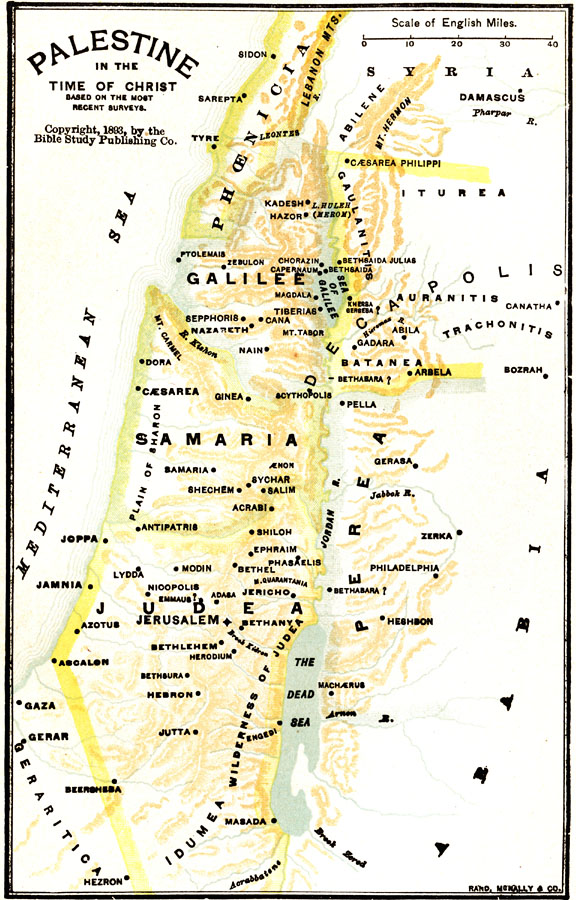
🏺 Twelve years old, the temple teachers, and the festival crowd
At twelve a Jewish boy was nearing the age when he would take on full responsibility for keeping the Law (the formal “son of the commandment” came a little later, but the preparation was underway). So this Passover was a fitting threshold. During the great feasts, respected teachers taught in the temple courts, and it was normal for students and seekers to sit, listen, and trade questions — the standard way of learning. Jesus takes exactly that humble learner’s posture, “listening and asking questions” — and yet His insight stuns the experts. As for the “losing” of Jesus: pilgrim caravans were large and often had the women and men in separate groups with children moving between them, which is how a careful mother and father could each assume the boy was with the other.
📜 “My Father’s house” — a thread Luke and John both pull
Calling the temple “My Father’s house” is a striking claim, and it reappears at the other end of the Gospels: when Jesus clears the temple, He says, “Stop making My Father’s house a place of business” (John 2:16). The prophet Malachi had promised, “the Lord… will suddenly come to His temple” (Malachi 3:1). Already at twelve, Jesus is at home in His Father’s house — the first sign of a Son who belongs there as no one else does.
How it ties to the rest of Scripture
| Passage | Connection |
|---|---|
| Malachi 3:1 | “The Lord… will suddenly come to His temple” — the Son already at home in His Father’s house. |
| John 2:13–17 | “My Father’s house” again — zeal for the temple at the start of His public ministry. |
| Deuteronomy 16:1–6 | The command to keep Passover in the place God chose — the pilgrimage the family is making. |
| Luke 9:22 | “The Son of Man must suffer” — the same “must” (dei) that first appears here at age twelve. |
Resources to explore
Play the video here, then dig into the text and its background.
🎬 Watch & listen
- Video: BibleProject — Luke 1–9Overview with study notes and downloads.
- Podcast: An Overview of LukeHow Luke builds his account of Jesus’ identity and mission.
📖 Study tools
- Luke 2:49 interlinear + Strong’sSee “I must be in My Father’s house” in the Greek.
- Full passage (Luke 2:41–50, NASB95)Read the whole text on Bible Gateway.
🔗 Cross-reading
- Malachi 3:1–4The Lord coming suddenly to His temple.
- John 2:13–22“My Father’s house” at the start of His ministry.
Discussion questions
- Of everything from Jesus’ childhood, Luke records only this. What is he choosing to show his readers about who Jesus already knew Himself to be?
- Mary says “your father and I”; Jesus answers “My Father.” To a first-century Jew, how startling would it have been for a boy to call God his Father in that direct way?
- Jesus is found “listening and asking questions” even as He amazes the teachers. How does that hold together real human learning with extraordinary insight?
- The word “must” (it is necessary) appears here for the first time and will drive the whole Gospel to the cross. What does it mean that Jesus lived under a holy “must” from age twelve?
- Only after all that does the question reach us: His parents “did not understand.” What does it look like for us, too, to keep trusting Jesus when His words run ahead of our understanding?