Event 15 — The Return to Nazareth
The tyrant is dead, and God calls His Son home. But not to a palace in Judea — to a quiet hill town in Galilee with a bad reputation, exactly where the prophets had hinted the Messiah would be found.
Called home — to the town nobody respected
After Herod dies, an angel tells Joseph it is safe to bring the Child back to the land of Israel. But Herod’s son Archelaus now rules Judea, and he is cruel enough that Joseph is afraid to settle there. Warned again in a dream, the family withdraws north to Galilee and makes their home in Nazareth — a small, unimportant village. Matthew sees the prophets fulfilled even in this: “He shall be called a Nazarene.” The Messiah grows up not in the corridors of power but in obscurity and low regard, a tender “branch” sprouting quietly from David’s cut-down family tree.
The text
Underlined words (like Nazarene) link down to their original-language card in Word secrets below.
19But when Herod died, behold, an angel of the Lord appeared in a dream to Joseph in Egypt, and said, 20“Get up, take the Child and His mother, and go into the land of Israel; for those who sought the Child’s life are dead.” 21So Joseph got up, took the Child and His mother, and came into the land of Israel.
22But when he heard that Archelaus was reigning over Judea in place of his father Herod, he was afraid to go there. Then after being warned by God in a dream, he left for the regions of Galilee, 23and came and lived in a city called Nazareth. This was to fulfill what was spoken through the prophets: “He shall be called a Nazarene.”
Luke adds: 39When they had performed everything according to the Law of the Lord, they returned to Galilee, to their own city of Nazareth.
Matthew 2:19–23; Luke 2:39 (NASB95)📖 Read the whole passage
Read it on Bible Gateway (NASB 1995), with Luke 2:39. Matthew and Luke agree on the destination — Nazareth — while telling the road there from their two angles. This closes the birth narrative and sets the stage for the hidden years.
What the original words mean
Four details that connect this homecoming to the larger story.
These are almost the exact words God spoke to Moses in Midian: “Go back to Egypt, for all the men who were seeking your life are dead” (Exodus 4:19). Matthew keeps the Moses echo ringing — Jesus is the new Deliverer, His early life patterned after Israel’s rescuer, only greater.
↑ Back to the passageWhen Herod died, his kingdom was split among his sons. Archelaus got Judea — and quickly proved so violent that Rome removed him within about ten years. His reputation is exactly why Joseph avoids Judea and heads for Galilee instead. Real history shapes where the Messiah grows up.
↑ Back to the passageThis is a word Matthew uses again and again when Jesus and His family step away from danger rather than confront it head-on. From the start, the King’s path is marked by humble withdrawal at the right moment — not weakness, but a wisdom that waits for God’s timing.
↑ Back to the passageMatthew says “the prophets” (plural), not one verse — he’s summing up a theme. Two threads meet here. “Nazareth” sounds like the Hebrew netzer, “branch,” the shoot from David’s fallen line (Isaiah 11:1). And to be “a Nazarene” was to be looked down on — fitting the prophets’ picture of a despised, rejected Messiah (Isaiah 53). Both meanings land on the same truth: the King would rise, lowly, from a place nobody honored.
↑ Back to the passageWhy Galilee, and not Judea
Herod’s kingdom was divided among his sons. The cruel Archelaus took Judea in the south; the milder Herod Antipas took Galilee in the north — so Galilee was the safer home.
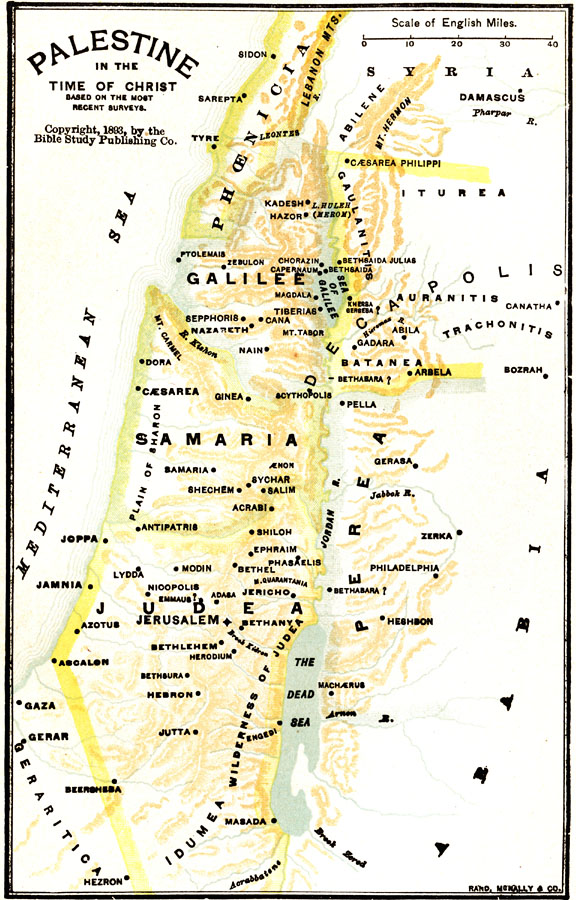
🏺 Nazareth’s reputation — “can anything good come from there?”
Nazareth was a small farming village in the hills of lower Galilee, off the main roads and never mentioned in the Old Testament. Galileans were already looked down on by Judeans as country folk, and Nazareth had no standing even among Galileans — later, Nathanael would scoff, “Can any good thing come out of Nazareth?” (John 1:46). To call someone “the Nazarene” was to mark them as a nobody from nowhere. That this is where God planted His Messiah is the whole point — the same God who chose a manger and shepherds chose this town.
📜 “The prophets” — branch and despised one
Matthew unusually cites “the prophets” in general, not a single text, which points to a theme rather than a quotation. Many hear a wordplay on netzer, the “branch” that would grow from the stump of Jesse (Isaiah 11:1) — new life sprouting from David’s cut-down dynasty. Others hear the prophets’ portrait of a Messiah “despised and forsaken of men” (Isaiah 53:3), since “Nazarene” carried contempt. The two readings reinforce each other: the royal Branch comes up in a despised place, and the world will not think much of Him.
How it ties to the rest of Scripture
| Passage | Connection |
|---|---|
| Exodus 4:19 | “All who sought your life are dead” — God’s words to Moses, echoed over Jesus. |
| Isaiah 11:1 | The “branch” (netzer) from the stump of Jesse — the wordplay behind “Nazarene.” |
| Isaiah 53:1–3 | The Servant “despised and forsaken” — the prophets’ despised Messiah, fitting a Nazarene. |
| John 1:45–46 | “Can any good thing come out of Nazareth?” — the town’s low reputation, stated outright. |
Resources to explore
Play the video here, then dig into the text and its background.
🎬 Watch & listen
- Video: BibleProject — Matthew 1–13Overview with study notes and downloads.
- Podcast: An Intro to Reading the GospelsHow the Gospels present Jesus as a real figure in history.
📖 Study tools
- Matthew 2:23 interlinear + Strong’sSee “Nazarene” (Nazōraios) in the Greek.
- Full passage (Matthew 2:19–23, NASB95)Read the whole text on Bible Gateway.
🔗 Cross-reading
- Isaiah 11:1–10The branch from Jesse’s stump and his righteous reign.
- Isaiah 53The despised and rejected Servant.
Discussion questions
- Matthew echoes God’s words to Moses — “those who sought the Child’s life are dead.” What is he teaching his readers by casting Jesus’ early life in the shape of the Exodus?
- Joseph makes real decisions based on real dangers (Archelaus) and on God’s guidance in dreams. How do you see divine guidance and ordinary wisdom working together here?
- “Nazarene” carried contempt in that world. Why might it matter to Matthew’s first readers that their Messiah grew up labeled a nobody from nowhere?
- The same word can mean both “branch” (royal hope) and “despised” (low regard). How do those two senses together capture the kind of King Jesus is?
- Only after all that does the question reach us: God hid His Son in obscurity for decades before any ministry. What might that say about the value of hidden, unimpressive seasons?